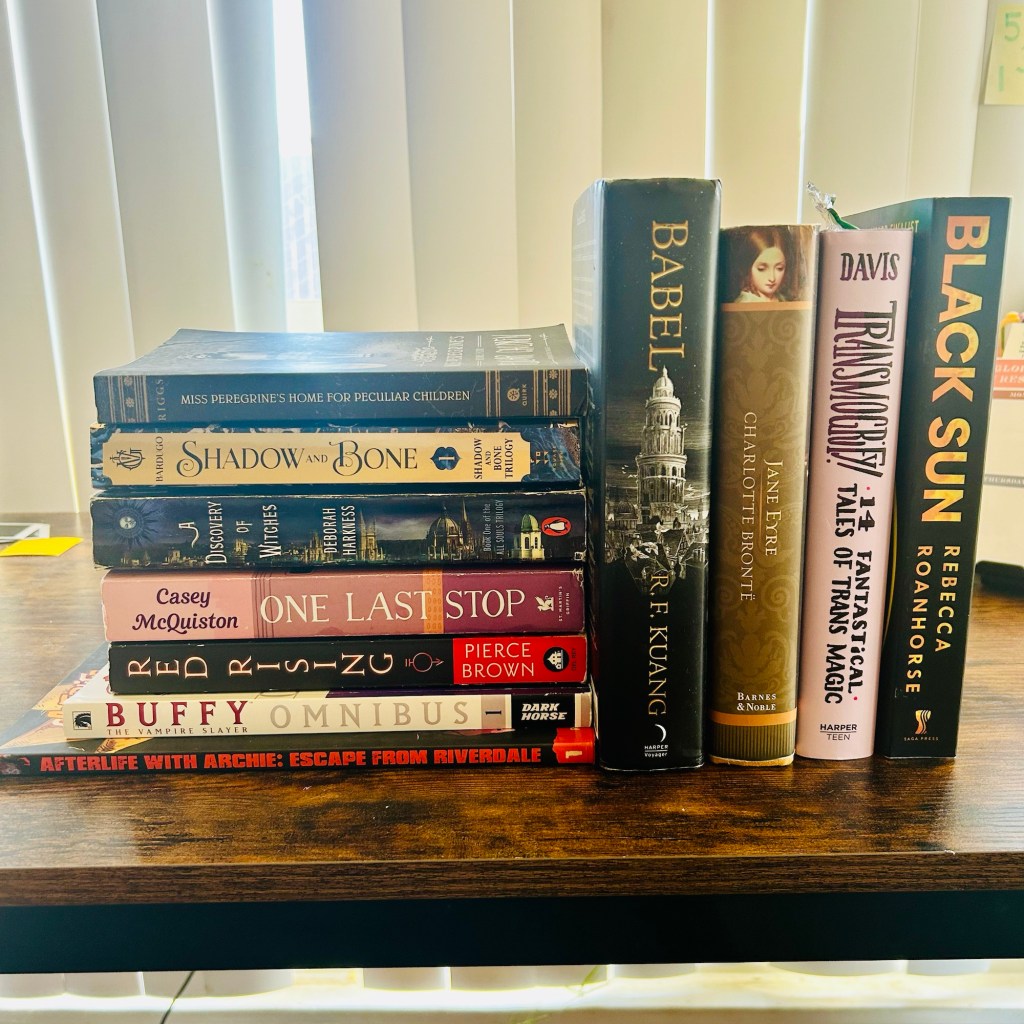
It’s a new school year and the end of so many chapters for me. Of stay-at-home motherhood (for the second time – is it supposed to get easier??), of not believing in myself, of being burnt out. I’ve spent the summer resting and helping my family rest, and now we’re all ready to take on this new season of life. That’s greatly impacted what I’ve wanted to write about. Consequently, I haven’t done much for my book in the last month or so, but I’ve had so much fun pouring over books and really soaking in other people’s work. I’ve read some great stuff, that I can’t wait to share with you over the next months.
I have been focused on all the ways the concept of school has impacted me, because my actual school experiences left much to be desired. So for a long time I lived in pretend schools and academy (I’m looking at you Vampire Academy LOL). And now I’m headed back to school to become better at this. Not just the creative part, but the professional parts are all going to matter soon, and I want to be ready for it. So while I’m getting ready to go back to the (online) classroom, I’m reading and reviewing many of the books that formed my impressions of school, and what being a student means.
For me, that starts with the classics. From Little Women to Pride and Prejudice, the “study of women” has always been an important reading interest for me. Now, those books don’t have school settings so they don’t exactly fit in this blog, but many of others do. The best, and one of my absolute favorites, is Jane Eyre. Jane’s existence is encircled by education, as her roles bounce in every sense between student and teacher. These (along with the very dramatic A Little Princess with Shirley Temple) formed my own idea of what being a teacher and student really meant. Though they were silly and so off-base as to be comical, they really cemented the relationship between teacher and student.
The best by far is Jane Eyre by Charlotte Brontë, because Jane does everything related to education for her time, and I’ve been inspired by her my whole life. “Educator” now means “any job in which children are placed first,” and it’s because Jane took that and ran with it. This very truly is my favorite book, and my first introduction to “fighting for change in the classroom.” And though that’s a literal joke I hope readers will chuckle at, it’s also one of metaphor, because even when Mr. Rochester nudges her into a position of student of intimacy to his doting, if a bit rude, teacher. Jane, for her part, fights back at every turn. Both in the girls’ school and to Mr. Rochester. “During these eight years my life was uniform, but not unhappy, because it was not inactive. I had the means of an excellent education placed within my reach’ a fondness for some of my studies, and a desire to excel in all, together with a great delight in pleasing my teachers, especially such as I loved, urged me on” (79). The school administrator nor Mr. Rochester stood a chance against her strength and resilience.
But she isn’t just a fighter. She also is a healer and a caregiver. It shows in the way she cares for her schoolmate, and it especially shows in the way she treats Adele. “… I took her on my knee; kept her there an hour, allowing her to prattle as she liked: not rebuking even some little freedoms and trivialities into which she was apt to stray when much noticed” (140). I LOVED the relationship between Jane and Mr. Rochester’s charge, the way she found deep attachment that really superseded her relationship with Mr. Rochester for much of the book, even when he was trying to make her like him more. This hit me DEEP as a kid. She been treated terribly at home and then at the very school she now teaches at, but instead of being part of the bad, part of the problem, she’s part of the reason the school is turned into a safe environment for girls.
Honestly this might be my first idea of feminism. Being part of the positive in change in every environment, even if she can’t experience it, like in her childhood home. But in school and at Mr. Rochester, and maybe even later while she’s off on her adventures after she learns about Mrs. Rochester LMAO Even Mr. Rochester’s relationship with himself and his household (including his wife) changed under Jane’s tutelage because even though he 100% deserved everything he went through I think Jane also helped prepare him for his punishment and made him someone almost worthy of her goodness. The house, however, 100% deserves such a wonderful Mistress, and I bet that whole lineage is lucky she decided to keep Rochester at all.
But we must move on from the old ways of teaching, and move into the modern, albeit trite to a 30-year-old “Typical High School” books. As I said, it’s been a long time since those books were relatable for me, but I was able to pull a few, and I’m just going to list them because, again. Not relatable Lol. But! If they’re relatable to you or bring back fun memories or inspire you to go on a Sarah Dessen binge reading marathon, who am I to stop you? She’s great!
- Dear Evan Hansen, by Val Emmich with Steven Levenson, Benj Pasek and Justin Paul (creators of the hit show)
- I’ve never loved lunch. There’s not enough structure. Everyone’s free to go where they please, and where they please is nowhere near me.” (23)
- What Happened to Goodbye by Sarah Dessen
- “‘Jackson High?’ The blonde at the keg rolled her eyes, sighing dramatically. “You poor thing. You’ll hate it.’”
- Comics
- Archie
- Buffy
It’s time to move on from the realistic and switch over to fantasy schools. There’s going to be one specific school I don’t mention, that anyone 35-11 can tell you would take up a page, but we’re going to keep the Author-Who-Should-Not-Speak-Online out of this blog for good. So, moving on. Academies and Magic Schools can both be places of freedom but they can also be prisons. And before I wrote this, I thought I had mostly positive examples of this kind of schooling, but it turns out my tastes got dark after real-life high school sucked ass.
Shadow and Bone by Leigh Bardugo is the most prison-like Academy because the Darkling literally steals children and makes them go to his school if they have magical powers. But it serves as a “come to power” feminist story, and Leigh Bardugo really knows how to sell an evil villain. Even though the Darkling gave off groomer vibes, I read through the series until there was a healthy male figure, and it was worth it. Rule of Wolves was fantastic.
But Agea and the trials in Red Rising by Pierce Brown is just as much a prison as the Little Castle in Shadow and Bone. There really aren’t many differences, in fact, besides contextual ones. The major one, however, is that the kids in Agea are at the top of a food chain that spans more social classes than those in Shadow and Bone. “‘It’s strange. I thought I knew so many Golds, but hardly any of them managed to get past the entrance exams. It’s a brave new world of faces, I fear. Anyway, I envy you the fact you haven’t been to Agea It’s a strange place, no doubt, but life there is fast, and cheap, so they say’” (117).
In both books the main character can see the distortion, and Darrow in Red Rising does everything he can to fight the urge to become one of the privileged. “I have not been here before. But I have seen the columns. Seen the destination of our voyage. Bitterness wells in me like bile rising from stomach to throat as I think of his face… I watched on the HC as the Arch Governor gave his speech time and again to the classes before my own. … Soon I’ll suffer the rage. Feel the fire lick over my heart as I see him in person once again.”
There’s also Ms. Peregrine’s Home for Peculiar Children by Ransom Riggs, which floats somewhere in the middle, if this quote is any indication. “And that is how someone who is unusually susceptible to nightmares, night terrors, the Creeps, the Willies, and Seeing Things That Aren’t Really There talks himself into making one last trip to the abandoned, almost-certainly-haunted house where a dozen or more children met their untimely end.” Nate’s comment, when I asked him about why he likes the series. “There’s a spark of adventure that really speaks to me.” I wish I’d read this book, because as he was explaining the many different story lines and plot twists, I can see where his own interest in traveling the world would be attracted to a book like this. He says it’s definitely worth the read.
But of course, there are still some that truly bring safety and learning to YA magic books, and they are delightful. Transmogrify, “Dragons Name Themselves” by A.R. Capetta and Cory McCarthy is the first example, because it is my favorite. The whole anthology of short stories are of course amazing (check my last blog post for a few of those!) but this one in particular has stood out. Of course, this is the best one by far, no contest. I’m still absolutely flummoxed by how perfect the story is. And it really starts from the beginning and just gets better. The first quote, “(When you’re a school filled with magical teenagers, the magic rubs off, but so does the swearing, It’s a very fucking real occupational hazard.)” (75) is at the very beginning and it truly sets the tone for the story. Not to mention, this is my favorite line in any story involving a magical school I’ve read. Ever. Still it isn’t the only good, school-related part of this story. The kids the school befriends are also delightful, and the school knows it. “Jak and Wynit were like me. And I was certain they would like each other.” (90) I don’t really feel like I need to say anything more than this. THE SCHOOL SET THE WHOLE THING UP. I just… there’s nothing better than an invested caregiver, and this is the most invested. And of course the best part of the story will end this, too. “I’m Herman!”
Our last and final section of this blog is dedicated to “The Old College Try.” Here we’ll have people just like you and me being spooked into or inspired to go to college because of something not quite in their control, be that supernatural or familial, but they all get there nonetheless. And many to high brow universities! I guess I learned during this blog that I appreciate higher education, even if it would take a lifetime to earn a place there myself. In any case, the books following this are amazing and worth the reads no matter how you feel about education.
The first two novels aren’t related in any way, except one: both stories involve people who aren’t quite sure how they ended up in the level of education they are. In One Last Stop by Casey McQuiston, the main character does a lot to avoid graduating, and it shows from the beginning. “It’s not English (her first major), or history (her second). It’s kind of psychology (third minor), but mostly it’s the same as everything else for the past four and a half years: another maybe this one, because she’s scraped together just enough course credits and loans, because she’s not sure what to do if she’s not living blue book to blue book until she dies” (16).
Obviously, I related to this book in a big way lol I’ve now tried several different careers, including unhappy desk worker, cat (child) herder of varying-sized groups, and advocate with varying titles. The second book, Ninth House by Leigh Bardugo, she is plucked literally from death’s doorstep to monitor rich kids while they do magic. “There are over a hundred societies at Yale at this point, but we don’t concern ourselves with most of them…It’s the Ancient Eight that matter. The landed societies. The Houses of the Veil. They’re the ones that have held their tombs continuously” (40). I particularly chose this quote because the history of school and society is always somehow bigger than the fact that the main character is just constantly traumatized, so it’s on theme to focus on the societies than the character’s relationship to the school.
The final two books are my best and favorite, I think. They’re deep fantasy but set in real world, just like my books will be. I would even argue they’re part of the foundation of finding this genre for myself. But these books do it better than I ever could. Babel by R.F. Kuang is a masterpiece. She creates a completely believable magic in the world that not only fits with factual events, she annotates both fictional and factual statistics in footnotes like the most badass history of the world that I could imagine. And her description of Babel is beyond perfection. “Of all the marvels of Oxford, Babel seemed the most impossible – a tower out of time, a vision from a dream. Those stained-glass windows, that high, imposing dome; it all seemed to have pulled straight from the painting in Professor Lovell’s dining room and dropped whole onto this drab grey street” (72). The imagery and precision of words is exemplary of the whole work, and absolutely stunning to a person as fascinated by word choice as I am.
The last book is the first of one of my favorite series, and I’m ending with it because of that. For it’s the deepest connection to both learning and teaching history that makes this story take the other end of this blog on education. It mirrors Jane Eyre for me in so many ways, because the characters hold the same morals, and I live by them, too. A Discovery of Witches by Deborah Harkness is a book about education to its finest, most minute points, and there’s a paragraph at the beginning that really hits that on the nose:
“Having observed the last scholarly propriety of exiting the library, I was free. My feet clattered against the linoleum floors and echoed against the stone walls as I sped through the reading room’s lattice gate, past the books guarded with velvet ropes to keep them from curious fingers, done the worn wooden stairs, and into the enclosed quadrangle on the ground floor. I leaned against the iron railings surrounding the bronze statue of William Herbert and sucked the chilly air into my lungs, struggling to get the vestiges of clove and cinnamon out of my nostrils.” (21)
Just like Jane Eyre, Diana walks the line between student and teacher often. Even from the beginning, she’s faculty at Oxford because she wished to study further. I’m inspired by that. I want to read and be allowed to talk about what I read and to constantly be learning. As someone with a learning disability I’m only starting to come to terms with, I’ve never been able to hold on to learning the way Diana does, but I’m learning, and hopefully this new school year is a bridge to that.
I’ll be covering Harnkness’ work next month in Sequel September, as the fourth (and final?) book of the All Souls Trilogy came out over the summer and I obviously bought it and will be reading it for the blog.
After writing this, it’s become pretty clear that I’ve gathered a wide range of examples of education to my bookshelves throughout the years. Some are positive ones, Jane Eyre and A Discovery of Witches and some are pretty problematic. But they’ve all served their purpose and deserve to be read by the people who need them. These books have come with me through hardships, attempts at school, and many moves.
I’m thankful to have the reminders of education, even as my own stopped, first to work in early education and then to start my family. To be back in this field, with writing being my job AND my school feels wonderful and full circle. I’m so excited to have the opportunity to grow my writing and writing community. To work with other writers and have feedback from teachers feels like the exact right move after sharing with the internet for the last two years. I’ll be focusing on my writing classes and teaching poetry to middle schoolers (eep!) and finishing my book.
But don’t worry! To make sure I’m still reading and resting, I’ll be blogging books still. Next month will be the sequels I didn’t get around to this summer, and October will be spooky-themed books that I reread every year. I can’t wait to share my favorite author with you! But since this is going to take so much of my time, I’m going to be signing out of social media for a while. I’ll be checking in from time to time when I’m ahead of my work (or maybe too stressed and need to check out for a minute or two). I’ll miss you all! But I hope your fall seasons are all cozy and filled with learning!
- Author Pages to Highlight
- Casey McQuiston: @casey.mcquiston
- RF Kuang
- Deborah Harkness
- Leigh Bardugo
- Pierce Brown
- Websites Highlighted:
- Even though I didn’t directly highlight these, it’s important to remember that if you need community, there are places for you!
- The Trevor Project: thetrevorproject.org
- Call, chat, or text
- Stand in Pride: standinpride.org
- Daniel Blevins, founder: @the_zombie_dan
- The Rainbow Youth Project: https://www.rainbowyouthproject.org/
- Human Rights Campaign: https://www.hrc.org/
- LGBTQ+ Suicide & Crisis Hotlines: https://988lifeline.org/
 Bernie's thoughts
Leave a comment